
MOHRE New Rules 2026: New Labour Law for Limited Contracts in UAE & Emiratisation Updates

Mohre New Rules. The UAE labour market has entered a new phase. Over the last few years, the Ministry of Human Resources and Emiratisation (MOHRE) has introduced major reforms to modernize employment rules. These changes affect every private-sector employer and employee in the UAE.
Following MOHRE updates, labour reforms, and compliance rules, the MOHRE New Rules 2026, the new labour law for limited contracts, and the updated Emiratisation law are not minor updates. They change how companies hire, pay, manage disputes, and protect workers.
What Is MOHRE New Rules?
MOHRE New Rules refer to the legal and administrative changes introduced under Federal Decree-Law No. 33 of 2021, its executive regulations, and later amendments up to 2026.
These rules officially replaced Federal Labour Law No. 8 of 1980, ending the old system and bringing a modern, flexible, and globally aligned labour framework.
The main goal is simple:
- Protect employee rights
- Give flexibility to employers
- Attract global talent
- Strengthen Emirati participation
- Improve dispute resolution
- Enforce fair wages and benefits
Why the UAE Changed Its Labour Laws
According to His Excellency Dr. Abdul Rahman Al Awar, Minister of Human Resources and Emiratisation, the new law strengthens the UAE’s position as one of the world’s most competitive labour markets.
The UAE wants a system that is:
- Flexible
- Efficient
- Skill-focused
- Fair to both employers and workers
The old labour law could not support modern work models like remote work, part-time roles, or job sharing. The new framework fixes this gap.
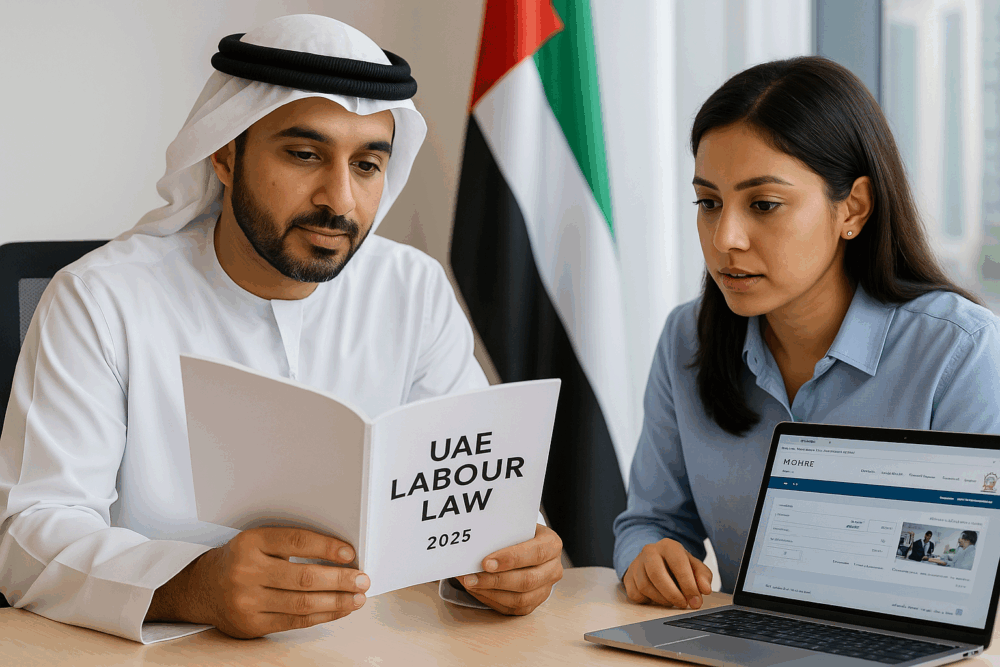
End of Indefinite Contracts in the UAE
Mandatory Limited (Fixed-Term) Contracts
One of the biggest changes under MOHRE rules is the end of unlimited contracts.
All private-sector jobs must now use limited contracts.
Key points:
- Contracts are fixed-term
- Renewable by agreement
- Maximum term is usually 3 years
- Renewal can happen multiple times
This rule applies to:
- Existing employees
- New hires
- Contract renewals
The goal is to create transparency and clarity for both sides.
New Labour Law for Limited Contracts in UAE
Limited contracts are now the standard across the UAE private sector.
What this means:
- Clear start and end date
- Defined job role and salary
- Defined notice period
- Clear termination rules
Termination rules:
- Either party must give notice
- Notice ranges from 30 to 90 days
- Early termination may require compensation
This protects employees from sudden job loss and employers from unexpected exits.
Six Approved Work Models Under MOHRE
The new law allows six official work models, giving flexibility never seen before in the UAE.
1. Full-Time Work
Employee works full daily hours for one employer.
2. Part-Time Work
Employee works for one or more employers for fewer hours or days.

3. Temporary Work
Work ends once the task or project is completed.
4. Flexible Work
Working hours or days change based on workload and business needs.
5. Remote Work
Work done fully or partially outside the office.
6. Job Sharing
Two or more employees share tasks and salary for one role.
Each model has clear rules for:
- Salary
- Leave
- End-of-service benefits
Leave Benefits Under MOHRE New Rules
Leave benefits have expanded significantly.
Maternity Leave
- 60 days total
- 45 days full pay
- 15 days half pay
Parental Leave
- 5 paid days
- For both parents
- Can be used within 6 months of birth or adoption
Bereavement Leave
- 5 days for spouse
- 3 days for parents, children, siblings, or grandparents
Study Leave
- 10 days per year
- For employees with 2+ years of service
- Must be studying at an approved institution
Annual Leave
- 30 days per year after one year of service
- 2 days per month for shorter service
These changes align UAE labour benefits with global standards.
Probation Rules Have Changed
Probation rules are now clearer and fairer.
New probation rules:
- Maximum probation: 6 months
- Employer must give 14 days’ notice
- Employee must give notice if leaving
If an employee leaves during probation to join another UAE employer:
- New employer may pay recruitment costs
This protects companies from hiring losses while allowing employee mobility.
Protection Against Discrimination and Harassment
The new labour law strongly bans:
- Forced labour
- Workplace harassment
- Bullying
- Discrimination based on gender, race, religion, or disability
Employers must now:
- Maintain respectful workplaces
- Investigate complaints properly
- Face penalties for violations
This is a major step toward safer work environments.
Wage Protection System (WPS)
MOHRE has strengthened the Wage Protection System.
What’s new:
- Faster salary transfers
- Direct bank integration
- Automated monitoring
- Stricter penalties for delays
Employers must pay salaries:
- On time
- Through WPS
- In full
Late payments can lead to:
- Fines
- Work permit bans
- Business restrictions
Mandatory Health Insurance in UAE – 2026 Rule
From January 1, 2026, health insurance is mandatory.
Who must be covered:
- All private-sector employees
- Domestic workers
Key rule:
- No residency issuance or renewal without insurance
Employers must:
- Provide basic health coverage
- Cover permit-linked insurance costs
This ensures healthcare access for all workers.
MOHRE Decisions Are Now Legally Binding
One of the most powerful changes in 2025 is MOHRE authority.

New power:
- MOHRE decisions are now writs of execution
This means:
- Decisions can be enforced directly
- Faster dispute resolution
- Less court delays
MOHRE can now decide disputes up to AED 50,000.
Salary Protection During Labour Disputes
New rules protect employee income.
What changed:
- Salary must continue for up to 2 months
- Applies during dispute resolution
This prevents financial hardship for workers during cases.
Non-Compete Clauses – New Limits
Non-compete clauses are now regulated.
Key rules:
- Maximum duration: 2 years
- Must protect legitimate business interest
- Invalid if employer breaches contract
This balances business protection and employee freedom.
Emiratisation Law Updates
Emiratisation rules have become stricter.
Companies with 20–49 employees:
- Must hire at least 2 Emiratis by 2026
- Previously required only 1
Non-compliance leads to:
- Financial penalties
- Work permit restrictions
This ensures greater Emirati participation in the private sector.
Training and Skill Development Initiatives
MOHRE continues to invest in skills.
Recent programs include:
- “Train the Trainer” initiative
- Domestic worker upskilling
- Talent development programs
These programs help improve productivity and service quality.
Public Holidays and Paid Leave Announcements
MOHRE regularly announces:
- Paid public holidays
- Private-sector holiday rules
- Upcoming national breaks
Employers must comply with paid holiday requirements.
Labour Laws in UAE 2022 Vs 2026
| Feature | 2022 | 2026 |
|---|---|---|
| Salary During Disputes | Not defined | Up to 2 months |
| Probation Notice | No clear rule | 14 days required |
| Work Models | Mostly full-time | 6 flexible models |
| Dispute Limit | Undefined | MOHRE up to AED 50,000 |
| Maternity Leave | 45 days | 60 days |
| Emiratisation | 1 Emirati | 2 Emiratis |
What These MOHRE Rules Mean for Employers
Employers must now:
- Update HR policies
- Budget for health insurance
- Ensure WPS compliance
- Meet Emiratisation targets
- Understand flexible contracts
- Handle disputes properly
Failure to comply can damage business operations.
What These MOHRE Rules Mean for Employees
Employees now enjoy:
- More job security
- Better leave benefits
- Health insurance protection
- Flexible work options
- Faster dispute resolution
- Stronger legal backing
The UAE labour market is now more worker-friendly than ever.
How to Check Official MOHRE Rules
To stay updated:

- Visit MOHRE official website
- Read Decree-Law No. 33 of 2021
- Use MOHRE Awareness Portal
- Follow official circulars
Avoid relying on outdated information.
Equal Pay Rule for Same Work
Under the new MOHRE labour framework, employees must receive equal pay if they have:
- The same job role
- The same level of experience
- The same responsibilities
Paying lower salaries based on gender, nationality, or background is illegal.
Any form of salary discrimination can lead to legal action against the employer.
Overtime Rules Clearly Defined
The new labour law clearly explains overtime rules.
- Work done after normal working hours is treated as overtime
- Overtime payment is calculated based on basic salary
- Work on rest days or public holidays is paid at a higher rate
Employers are not allowed to force overtime without proper payment.
Working Hours Limit in the Private Sector
According to MOHRE rules for the private sector:
- Maximum working hours: 8 hours per day
- Weekly limit: 48 hours
- Working hours are reduced during Ramadan
For part-time and flexible contracts, working hours depend on the contract terms.
Weekly Paid Rest Day Is Mandatory
Every employee is entitled to:
- At least one paid weekly rest day
- Usually Friday or Sunday
If an employee works on a rest day, the employer must provide extra pay or compensatory leave.
End-of-Service Gratuity Rules Updated
Gratuity is now calculated based on limited contracts.
- 1 to 5 years of service: 21 days of basic salary per year
- More than 5 years: 30 days of basic salary per year
- Maximum cap: equivalent of 2 years’ salary
For part-time and flexible workers, gratuity is calculated on a proportional basis.
Mandatory Conversion of Unlimited Contracts
MOHRE made it mandatory that:
- Old unlimited contracts must be converted into limited contracts
- Employers who delayed conversion may face penalties
Currently, only limited contracts are legal in the private sector.
Domestic Workers Law Fully Integrated
Domestic workers are now protected under a separate and strong legal framework.
- Governed by Decree-Law No. 9 of 2022
- Health insurance is mandatory
- Weekly rest day is compulsory
- Paid leave rights are clearly defined
Previously, domestic workers did not have this level of protection.
Work Permit Categories Expanded
MOHRE has expanded the range of work permits.
There are now 12 different types of work permits, including:
- Golden Visa work permit
- Student work permit
- Freelance permit
- Temporary work permit
This expansion has increased legal employment options in the UAE.
Absconding Rules Reformed
The old absconding system was often misused, so MOHRE introduced reforms.
- False absconding reports are punishable
- Employees are given a chance to present their side
- A digital investigation process is followed
Employers can no longer misuse absconding reports.
Labour Ban Rules Relaxed
Under the new labour law:
- Labour bans are not applied automatically
- Each case is reviewed individually
- Skilled and professional workers can have bans removed more easily
This has improved job mobility and career growth.
Termination Without Notice in Special Cases
In serious cases, employers may terminate an employee without notice, such as:
- Fraud
- Use of fake documents
- Serious misconduct
However:
- Proper evidence is required
- MOHRE approval is very important
Employee Data and Privacy Protection
Employers are responsible for:
- Protecting employee personal data
- Not sharing data without permission
- Securing digital HR systems
Unauthorized sharing of employee data is illegal.
Contract Language Clarity Rule
MOHRE requires that:
- Contract language must be clear and easy to understand
- Employees must fully understand contract terms
- The Arabic version of the contract is legally binding
Misleading or unclear clauses may be declared invalid.
Labour Complaint Filing Is Easier Now
Employees can now file complaints easily through:
- The MOHRE online portal
- MOHRE call center
- MOHRE mobile application
In most cases, a physical visit is no longer required.
Blacklisting of Non-Compliant Companies
Companies that repeatedly violate labour laws may face:
- Blacklisting
- Blocking of new visas
- Suspension of work permits
This rule has strengthened employer compliance.
Salary Deductions Are Strictly Controlled
Employers:
- Can deduct salary only for legal reasons
- Must have written approval
- Cannot make arbitrary salary cuts
Unjustified salary deductions are illegal.
Contracts Cannot Reduce Legal Rights
No employment contract can:
- Offer benefits lower than MOHRE law
- Override labour law protections
Any clause that goes against the law becomes automatically void.
Emiratisation Skill-Level Monitoring
MOHRE now monitors more than just Emirati hiring.
It also checks:
- Job role authenticity
- Skill level
- Career development
Fake or paper-based Emiratisation practices can lead to heavy fines.

AI-Based Digital Enforcement System
MOHRE has introduced advanced AI-based systems to monitor:
- Wage Protection System (WPS)
- Work permits
- Visas
- Labour complaints
All systems are interconnected, and violations are flagged automatically.
Alignment With Global Labour Standards
The main goal of these reforms is to:
- Position the UAE as a global talent hub
- Increase employer confidence
- Fully protect employee rights
FAQs About MOHRE New Rules UAE
What are the MOHRE new rules in the UAE?
Ans: MOHRE new rules are updated labour laws introduced under Federal Decree-Law No. 33 of 2021 and later amendments. These rules focus on limited contracts, flexible work models, better leave benefits, Emiratisation targets, health insurance, and faster dispute resolution.
Are unlimited contracts still allowed in the UAE?
Ans: No. Unlimited contracts are no longer allowed. All private-sector employees must now work under limited or fixed-term contracts that can be renewed by agreement between employer and employee.
What is a limited contract under the new UAE labour law?
Ans: A limited contract is a fixed-term employment agreement with a clear start and end date. It defines salary, job role, notice period, and termination conditions.
What is the maximum duration of a limited contract in UAE?
Ans: A limited contract can be issued for up to three years and can be renewed multiple times with mutual consent.
What are the new work models introduced by MOHRE?
Ans: MOHRE allows six work models:
- Full-time
- Part-time
- Temporary
- Flexible
- Remote
- Job-sharing
These models give employers and employees more flexibility.
Is remote work legal under UAE labour law?
Ans: Yes. Remote work is fully legal. Employees can work fully or partially outside the workplace under approved remote work contracts.
How many days of maternity leave are allowed in UAE now?
Ans: Female employees are entitled to 60 days of maternity leave. This includes 45 days with full pay and 15 days with half pay.
What is parental leave under MOHRE rules?
Ans: Parental leave allows both parents to take 5 paid working days within six months of a child’s birth or adoption.
Conclusion
The MOHRE New Rules 2026, the new labour law for limited contracts, and the updated Emiratisation law have completely reshaped employment in the UAE.