
Mohr’s Circle Calculator 2026: Complete Guide To Principal Stress And Formulas
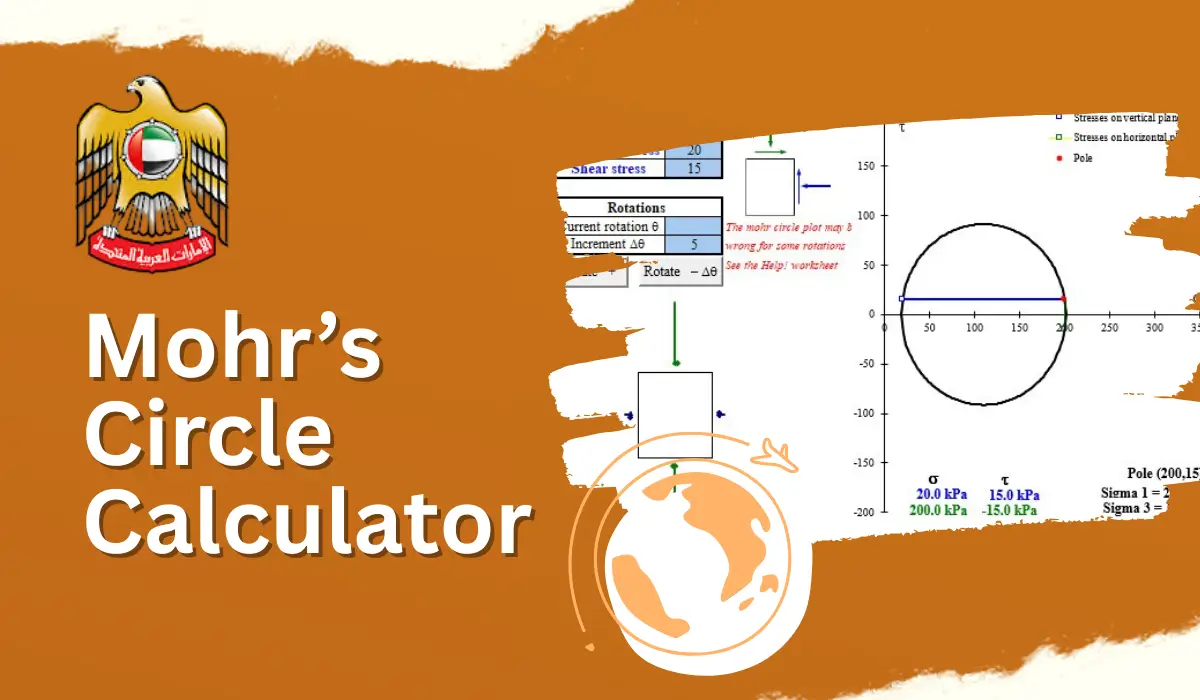
Mohr’s Circle Calculator. When designing any machine part, metal structure, or beam, stress analysis is very significant. If internal stresses are not calculated correctly, the material can fail. A Mohr’s Circle Calculator helps engineers understand a 2D stress state using normal stresses and shear stress values. It quickly calculates principal stresses, maximum and minimum values, maximum shear stress, mean stress, angle of orientation, and von Mises stress. Instead of solving long equations manually, this calculator provides both analytical results and a graphical Mohr’s circle.
By entering stress values and selecting units like MPa or psi, users can generate accurate results instantly. In this guide, you will learn stress concepts, formulas, circle drawing steps, and practical examples in simple terms for easy comprehension.
Mohr’s Circle for Plane Stress
How to Use the Mohr’s Circle Calculator
Using this calculator is very simple. Just follow these steps carefully.
- Enter the normal stress value along the X-axis (σx).
- Enter the normal stress value along the Y-axis (σy).
- Enter the shear stress value in the XY plane (τxy).
- Use positive value for tension and negative value for compression.
- Select the correct stress unit from the dropdown menu.
- Make sure all values use the same unit.
- Click the “Calculate” button to process the data.
- View the principal stresses (σ₁ and σ₂) in the results section.
Disclaimer
This Mohr’s Circle Calculator provides results based on the values entered by the user and standard stress equations. Please verify calculations before using them for real engineering design or safety-critical applications.
What is Stress?
Imagine you press a book between your hands. The book feels force. Inside the book, small internal forces are created. These internal forces are called stress. There are two main types of stress:
- Normal Stress (σ) – Acts straight on the surface.
- Shear Stress (τ) – Acts along the surface and tries to slide it.
If you pull a rod from both sides, that is normal stress. If you try to twist it, that is shear stress.
What is a Stress State?
A stress state means all stresses acting at a single point in different directions. In 3D space, we have three directions:
- X direction
- Y direction
- Z direction
In each direction, stress can act. So total stresses at a point include:
- 3 Normal stresses
- 3 Shear stresses
That makes 6 stress components. But in many real problems, we only study a flat surface. That is called 2D stress state or plane stress.
2D Stress State (Plane Stress Condition)
In 2D stress state, we only consider:

- σxx (normal stress in X direction)
- σyy (normal stress in Y direction)
- τxy (shear stress)
All other stresses are taken as zero. This makes calculation simple and practical for thin plates and sheets.
What is Principal Stress?
Principal stress is very important. It is the stress acting on a plane where shear stress becomes zero.
In simple words: If you rotate a small square element slowly, at one special angle, the sliding force disappears. Only straight pressure remains. That pressure is called principal stress. In 2D, we get:
- σ₁ → Maximum principal stress
- σ₂ → Minimum principal stress
Principal Stress Formula (2D Case)
If you know:
- σxx
- σyy
- τxy
Then principal stresses are calculated as:
σ₁ = (σxx + σyy)/2 + √[ ((σxx − σyy)/2)² + τxy² ]
σ₂ = (σxx + σyy)/2 − √[ ((σxx − σyy)/2)² + τxy² ]
Where:
- σ₁ is maximum principal stress
- σ₂ is minimum principal stress
Maximum Shear Stress Formula
Maximum shear stress is given by:
τmax = √[ ((σxx − σyy)/2)² + τxy² ]
OR
τmax = (σ₁ − σ₂)/2
Mean Stress Formula
Mean stress is: σmean = (σ₁ + σ₂)/2

It is actually the center of Mohr’s circle.
Angle of Orientation
The angle at which principal stress occurs is:
2θ = tan⁻¹ ( 2τxy / (σxx − σyy) )
This angle tells how much you rotate the element to remove shear stress.
What is Mohr’s Circle?
Mohr’s Circle is a graphical method to find:
- Principal stresses
- Maximum shear stress
- Angle of rotation
- Mean stress
Instead of solving equations again and again, we draw a circle. That circle gives all answers visually. Think of it like this:
- Math method = Using formulas
- Graph method = Using Mohr’s circle

How to Draw Mohr’s Circle (Step-by-Step)
Let’s take an example:
σxx = 80 MPa
σyy = 20 MPa
τxy = 30 MPa
Now follow these steps carefully:
Step 1: Draw Axes
Draw two axes:
- Horizontal axis → Normal stress (σ)
- Vertical axis → Shear stress (τ)
Step 2: Plot Two Points
- Point A = (σxx, τxy)
- Point B = (σyy, -τxy)
Step 3: Join A and B
- Connect both points. This line becomes diameter.
Step 4: Find Center
Center = (σxx + σyy)/2
= (80 + 20)/2
= 50 MPa
Step 5: Calculate Radius
Radius = √[ ((80 − 20)/2)² + 30² ]
= √[ (30)² + 900 ]
= √(900 + 900)
= √1800
Step 6: Draw Circle
- With center at 50 MPa and calculated radius, draw circle.
- Where circle cuts X-axis → those are principal stresses.
Understanding the Output
After calculation, you will see:

- Circle diagram
- Center value
- Radius value
- Principal stresses
- Analytical solution
- Angle of principal plane
This helps you verify the answer easily.
Von Mises Stress
Von Mises stress helps predict failure in ductile materials like steel.
In 2D case: σv = √( σ₁² − σ₁σ₂ + σ₂² )
If Von Mises stress is greater than material yield strength, material may fail.
3D Stress State
In 3D case, principal stresses are found using polynomial equation:
- σ³ − Aσ² + Bσ − C = 0
Where:
- A = σx + σy + σz
- B = σxσy + σyσz + σxσz − τxy² − τyz² − τxz²
- C = σxσyσz + 2τxyτyzτxz − σxτyz² − σyτxz² − σzτxy²
From this equation, we get:
- σ₁ (maximum)
- σ₂ (middle)
- σ₃ (minimum)
Maximum Shear Stress in 3D
- τmax₁ = (σ₂ − σ₃)/2
- τmax₂ = (σ₁ − σ₃)/2
- τmax₃ = (σ₁ − σ₂)/2
Complete Solved Example
Given:
- σxx = 100 MPa
- σyy = 40 MPa
- τxy = 20 MPa
Step 1: Mean Stress
= (100 + 40)/2
= 70 MPa
Step 2: Difference Square
(100 − 40)/2 = 30
30² = 900
Step 3: Add Shear Square
900 + 400 = 1300
Step 4: Square Root
√1300 = 36.05
Step 5: Principal Stresses

σ₁ = 70 + 36.05 = 106.05 MPa
σ₂ = 70 − 36.05 = 33.95 MPa
Step 6: Maximum Shear Stress
τmax = (106.05 − 33.95)/2
= 36.05 MPa
Everything matches perfectly.
Why Mohr’s Circle is Important in Engineering?
Engineers use it in:
- Machine design
- Structural analysis
- Pressure vessels
- Shafts
- Bridges
- Aerospace components
Without stress transformation, safe design is not possible.
Advantages of Mohr’s Circle Calculator
- Saves time
- Reduces errors
- Fast results
- Visual understanding
- Easy for students
- Useful for engineers
Quick Formula Summary Table
| Parameter | Formula |
|---|---|
| σ₁ | (σxx+σyy)/2 + √[((σxx−σyy)/2)² + τxy²] |
| σ₂ | (σxx+σyy)/2 − √[((σxx−σyy)/2)² + τxy²] |
| τmax | (σ₁ − σ₂)/2 |
| σmean | (σ₁ + σ₂)/2 |
| Angle | 2θ = tan⁻¹ (2τxy / (σxx − σyy)) |
FAQs
What is a Mohr’s Circle Calculator?
Ans: A Mohr’s Circle Calculator is an online tool used to calculate principal stresses, maximum shear stress, mean stress, and angle of orientation from a 2D stress condition. Instead of solving long formulas manually, you just enter the stress values, and the calculator gives instant and accurate results. It also helps in understanding stress transformation clearly.
What inputs are required in the calculator?
Ans: To use the Mohr’s Circle Calculator, you need three main inputs. These include normal stress in the X direction (σxx), normal stress in the Y direction (σyy), and shear stress (τxy). Once these values are entered correctly with proper signs, the calculator processes them using principal stress equations.
What are principal stresses?
Ans: Principal stresses are the maximum and minimum normal stresses at a specific point where shear stress becomes zero. They act on special planes known as principal planes. These stresses are very important because they help engineers identify the most critical stress conditions inside a material.

How do you calculate principal stress manually?
Ans: Principal stresses can be calculated using mathematical formulas. First, you find the average of σxx and σyy. Then you add and subtract the square root term that includes the difference of normal stresses and shear stress squared. This gives maximum principal stress (σ₁) and minimum principal stress (σ₂). The calculator performs this entire process automatically.
What is maximum shear stress?
Ans: Maximum shear stress is the highest sliding force acting at a point inside a material. It represents the maximum tendency of the material to deform by sliding. In Mohr’s Circle, it is equal to the radius of the circle. It can also be calculated by dividing the difference between principal stresses by two.
What is mean stress?
Ans: Mean stress is the average of the two principal stresses. It represents the center point of Mohr’s Circle on the normal stress axis. This value helps in understanding the overall stress condition acting on the material.
What is the angle of orientation in Mohr’s Circle?
Ans: The angle of orientation is the angle at which principal stress occurs and shear stress becomes zero. It tells how much the element needs to rotate to reach the principal plane. This angle is calculated using a tangent inverse formula involving shear stress and the difference between normal stresses.
What is Von Mises stress?
Ans: Von Mises stress is a calculated value used to predict material failure, especially in ductile materials like steel. If the Von Mises stress becomes greater than the yield strength of the material, the material may start to fail. It is widely used in mechanical and structural design.
Can Mohr’s Circle be used for 3D stress?
Ans: Yes, Mohr’s Circle can be extended to three-dimensional stress conditions. In 3D, there are three principal stresses and three maximum shear stresses. The calculations become more advanced, but the concept remains the same.
Why is Mohr’s Circle important in engineering?
Ans: Mohr’s Circle is very important because it helps engineers understand stress transformation clearly. It ensures safe design of machine parts, beams, pressure vessels, and structures. By knowing the maximum stress and shear stress, engineers can prevent failure and improve safety. It is one of the basic and most powerful tools in engineering mechanics.
Conclusion
Mohr’s Circle Calculator is a complete tool for stress analysis. It helps calculate principal stresses, maximum shear stress, mean stress, orientation angle, and Von Mises stress from a 2D stress state. It combines mathematical formulas and graphical understanding in one place. By entering normal and shear stresses, users quickly get accurate results. This tool saves time, reduces errors, and helps engineers design safe and strong structures with confidence and better understanding of stress transformation.